
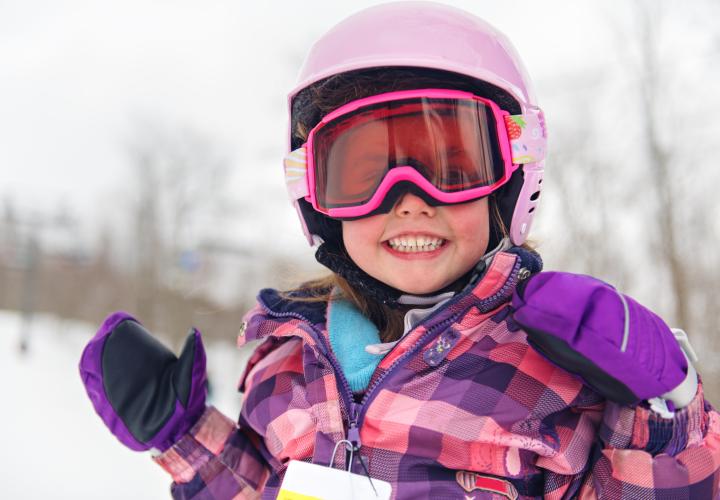
If you are like me, then you appreciate all four seasons. Of them, winter is my favorite. Through our work in the Injury Prevention Center, an initiative of Connecticut Children’s Office for Community Child Health, I see how winter can be a time for incredible fun — snow forts, skiing, and skating — and also a season that brings a few unique safety concerns. With a little planning, families can enjoy everything winter has to offer while helping keep children safe.
Winter Sports and Activities
Parents and caregivers should inspect equipment and the environment for possible hazards before children engage in winter activities such as sledding, ice skating and skiing. Remind children not to push, shove, or roughhouse while engaging in sports, and tell them always to wait their turn.
Snowballs
While it can be fun to build a snow fort or create a snow family, throwing snowballs can be dangerous if a child gets hit in the eye. Some snowballs are icy or even have rocks inside. Make being outside fun and stick to building, creating, and sledding.
Ice Skating
Each year, thousands of children end up in emergency departments due to skating injuries. The vast majority of these injuries result from falls. With care, skating can be enjoyable and even children as young as age 4, as long as they are steady walkers, can enjoy the sport. Allow children to skate only on approved surfaces. If on a lake, river, or pond, check for signs posted by local police or recreation departments, or call your local police department to find out which areas have been approved. Children should be taught to:
- Skate in the same direction as the crowd.
- Avoid darting across the ice.
- Never skate alone on lakes, rivers, and ponds.
- Never go out on ice that an adult has not approved.
- If a child falls through the ice, they should stretch their arms over the ice and kick as if swimming, in an attempt to crawl back onto the solid ice.
- Wear a helmet to protect against head injuries.
Sledding
An estimated 20,000 children ages 5 to 14 are treated in emergency departments for injuries related to sledding. Parents and caregivers should remember the following tips:
Parents should ensure that children:
- Sled only on terrain that is free of obstacles.
- Make sure the bottom of the slope is far from streets and traffic.
- Always use a sled with a steering mechanism. Avoid makeshift sleds.
- Avoid lying flat on the sled while riding downhill. Always sit up with feet forward — lying flat increases the chance of head and abdominal injuries.
- Never ride in a sled that is being pulled by a motorized vehicle.
- Make sure the number of children riding on the sled does not exceed the manufacturer's recommendations.
Snow Skiing and Snowboarding
With a few safety precautions, skiing and snowboarding are sports that even young children can enjoy. Parents should make sure children follow these suggested precautions:
- Enroll in at least one skiing/snowboarding lesson to start off on the right track.
- Use caution when entering and exiting the ski lift.
- Do not ski out of control or go too fast.
- Be aware of other people on the slope.
- Wear a ski helmet and eye protection (required on almost all slopes).
- Wear sun protection even on cloudy days.
- Never ski alone. An adult should always supervise young children.
Snowmobiling
Snowmobiles can weigh up to 600 pounds and travel at speeds in excess of 90 mph. Head injuries are the leading cause of snowmobile-related deaths. The American Academy of Pediatrics has stated that operating snowmobiles is inappropriate for children under age 16. If a child is riding as a passenger on a snowmobile, be sure he is wearing an approved helmet.
Winter Drowning
Most parents associate drowning with summer months, but the increased use of hot tubs and whirlpools, as well as the danger of hidden bodies of water or weak ice, make winter drownings a risk as well. To minimize drowning dangers, parents and caregivers should:
- Supervise children in or near a pool, hot tub, or any open body of water.
- Beware of children overheating in hot tubs and whirlpools.
- Make sure pools and spas are secure. If you have a pool or spa, install four-sided isolation fencing that is at least five feet high. The fence should have a self-closing and self-latching gate. Do not use the exterior of the house as one side of the fence.
- Allow children to skate only on ponds or lakes that have been approved for skating.
Frostbite
Exposure to cold without adequate protection can result in frostbite. Parents can protect their children by following these precautions:
- Dress children warmly. Several thin layers will help keep children dry as well as warm. Clothing should consist of thermal long johns, turtlenecks, one or two shirts, pants, a sweater, a coat, warm socks, boots, gloves or mittens, and a hat.
- Set reasonable time limits on outdoor play. Call children in periodically to warm up with drinks such as hot chocolate.
- When possible, avoid taking infants outdoors when it is colder than 40 degrees Fahrenheit. Infants lose body heat quickly.
If a child complains of numbness or pain in the fingers, toes, nose, cheeks, or ears while playing in the snow, or if his skin is blistered, hard to the touch, or glossy, be alerted to the possibility of frostbite and take the following steps:
- Take the child indoors.
- Call a doctor.
- Tell the child to wiggle the affected body part(s) to increase blood supply to that area.
- Warm the frozen part(s) against the body. Hold fingers to the chest, for example.
- Immerse frozen part(s) in warm, not hot, water. Frozen tissue is fragile and can be damaged easily. Avoid warming with high heat from radiators, fireplaces or stoves, and avoid rubbing or breaking blisters.
Pedestrian Safety
- Slippery driveways and sidewalks can be particularly hazardous in the winter. Keep them well shoveled and apply materials such as rock salt or sand to improve traction.
- Make sure that children under age 10 do not cross streets alone, and make sure children wear appropriate shoes and brightly colored (not white) clothing while walking in snowy conditions. Use retroreflective clothing or stickers for maximum protection, especially at dawn and dusk.
Visit Watch For Me CT for more information on pedestrian safety.
Home Safety
- Ensure that Smoke and CO detectors are tested and installed on every level and in any room where someone sleeps.
- Space heaters should be kept at least three feet from other objects, including furniture, and be turned off when nobody is in the room.
Visit Safe Kids Connecticut for more information on home and fire safety.
When families are prepared and supported by trusted guidance, your child’s winter wonderland can be a safe and fun-filled adventure.