Bethany Simonetti, MSN, APRN, Neurosurgery Nurse Practitioner (And Mom of 3!)

This article was originally published in 2023 and was last updated July 29, 2026 with additional information.

Why do some babies have rounded heads, while others have a cone, uneven or flat shape?

If you've noticed a flat spot or uneven head shape, don’t panic. Most head shape differences are harmless and improve with time, but knowing what to watch for can give you peace of mind.

Connecticut Children’s Neurosurgery Nurse Practitioner, Bethany Simonetti, addresses babies’ head shapes and 10 things parents should know.

Want more articles like this from pediatric experts you trust?

Sign up for our newsletter.

1. It’s common for a baby’s head to appear uneven or flat—and most of the time the head shape improves on its own with time.

Here are some questions to consider about your baby’s head shape:

  • Was your baby delivered vaginally, or via c-section?
  • Were they born prematurely or did they spend time in the NICU? 
  • How did they position themselves while in the whom? (We know, you wouldn’t know that!)
  • Do they favor one side while sleeping or looking at something?
  • Do they spend a lot of time flat on their backs? And yes, for safe sleep, back is always, always a must according to the American Academy of Pediatrics.

The above factors contribute to how your baby’s head is shaped. For example, it’s normal for babies to have a slightly flattened spot on the back of their head simply from lying down. In most cases, this resolves itself.  But if you are noticing your baby’s head shape is not improving mention it to your pediatrician.

>Related: Is Your Baby on Track for Motor Milestones?


2. Head shape is just one piece of your baby's development.

Your pediatrician doesn't just look at your baby's head shape- they're also checking how your baby is growing, moving and meeting developmental milestones.

As babies gain head control, roll over, sit up and crawl, they naturally spend less time lying on their backs. This helps take pressure off one area of the head and allows the skull to round out over time.

If your pediatrician has any concerns, they'll let you know whether an additional evaluation with pediatric neurosurgery is needed.
 

3. Your pediatrician may refer you to a pediatric neurosurgeon if they suspect your baby has an abnormally shaped head.

How do you know if your baby's head may be misshapen?

At a milestone visit, your pediatrician will look for:

  • Large, flat spots that aren't improving, especially by 4 months old
  • Flat, rather than curved, back of the head
  • Facial asymmetry or ear shift
  • Classic parallelogram shape, meaning the forehead looks pushed forward and the back of the head is flat (plagiocephaly)
  • Long and narrow head shape (dolichocephaly)
  • Generalized flatness across the back of the head (brachycephaly)

>Related: What to Expect at Your Baby’s First Pediatrician Visit
 

quote icon

Most of the time, surgery is not necessary to correct a baby’s head shape. But sometimes, it can help for a condition called craniosynostosis.

Bethany Simonetti, MSN, APRN, Neurosurgery Nurse Practitioner ,
Connecticut Children's

4. Sometimes a flat spot starts with a tight neck muscle.

Does your baby almost always look to the same side? They may have torticollis, a condition that causes tightness in the muscles on one side of the neck.

When babies consistently rest or sleep with their head turned in one direction, they place repeated pressure on the same part of the skull. Over time, this can contribute to a flattened area.

The good news is that torticollis is very treatable. Your pediatrician may recommend physical or occupational therapy or a home exercise program to gently improve your baby's range of motion while encouraging a more balanced head position. 
 

5. Your baby may benefit from a cranial remolding helmet, most commonly between 4 and 12 months old, though some babies may benefit up to 18 months of age.

Baby cranial remolding helmets are custom designed for your baby and work by relieving pressure on the flatter parts of the head as it continues to grow.

Your baby should not feel any pain or discomfort from wearing them, though the decision to get a helmet for your baby is a personal one. If you decide to pursue a cranial remodeling helmet for your baby’s head shape, Connecticut Children’s pediatric neurosurgery team is here to connect you with the resources to make it happen. 

As a mom myself who has gone through this process with my own children, I know how personal this decision can be. If you have questions, we can talk through all options and I help you make the best decision for your baby. 
 

6. Don't expect changes overnight.

Even though babies' heads grow quickly during the first year, changes in head shape still take time.

Whether your family is trying repositioning techniques, increasing tummy time or using a cranial remolding helmet, improvement usually happens gradually over weeks or months- not days.

The important thing is to continue following your care team's recommendations and keep your baby's routine well-child appointments so progress can be monitored. 
 

7. There are ways to help shape your baby’s head naturally, but check with your pediatric neurosurgeon or pediatric occupational therapist first.

Here are some things you can do—and might already be doing!—to help encourage a healthy baby head shape:

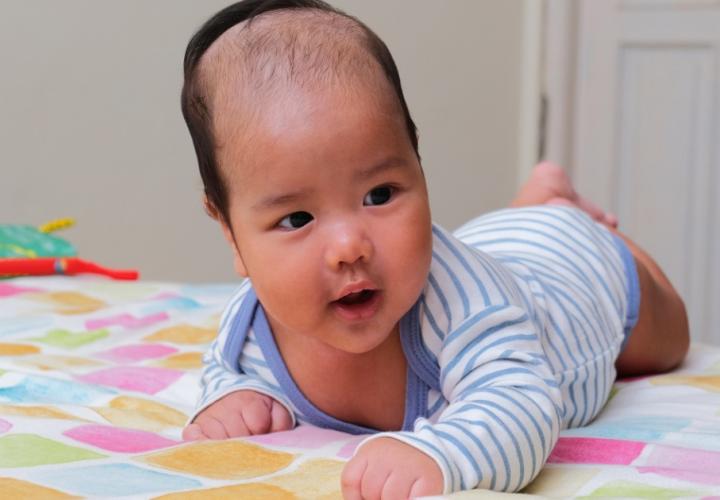
  • Tummy time—place your baby on their stomach while awake, and always have an adult supervise them. Tummy time is an early exercise with important developmental benefits for the muscles, bones and nervous system. Start doing tummy time correctly from day one.
  • Carrying or “wearing” baby more often—if you are able, try to spend more time during baby’s first few months carrying them so they are not constantly on their backs, which we know can lead to slightly flattened heads.
  • Change the position of baby’s “eye candy”—does your baby have a favorite toy, mobile or design they like to gawk over? Move it! Subtle changes in positions can help encourage a healthy head shape as baby matures. 
     

Concerned About Your Baby's Head Shape?

The most common head shape differences include plagiocephaly (flat spot on one side), brachycephaly (flat across the back of the head) and dolichocephaly (a long, narrow head shape). Our pediatric neurosurgery team can evaluate your baby's head shape and recommend the right next steps.

8. Most of the time, surgery is not necessary to correct a baby’s head shape. But sometimes, it can help for a condition called craniosynostosis.

Unlike misshapen baby heads that are caused by birth or lifestyle factors, craniosynostosis happens when the bones in a baby’s skull fuse together too early, well before the baby’s brain fully forms. Thankfully craniosynostosis is completely fixable thanks to advances in pediatric neurosurgery including options for minimally invasive surgery if diagnosed before six months of age.

9. A flat head doesn't mean your baby isn't growing.

This is one of the most common questions parents ask—and fortunately, the answer is reassuring.

In most cases, positional head shape differences, like plagiocephaly or brachycephaly, affect the shape of the skull, not brain development.

Your pediatrician will continue measuring your baby's head growth and monitoring development at each visit. If there's concern for a different condition, such as craniosynostosis, they may refer your baby to a pediatric neurosurgeon for further evaluation.
 

10. Of course, if something doesn't look right, trust your instincts.

You know your baby best.

If you notice your baby's head shape isn't improving, they always turn their head one way, or something simply doesn't seem right, bring it up with your pediatrician. You don't have to wait until the next scheduled visit.

Most head shape differences are harmless and improve with time, but early evaluation can provide reassurance or identify babies who may benefit from additional treatment while they're still in the ideal window for care.