
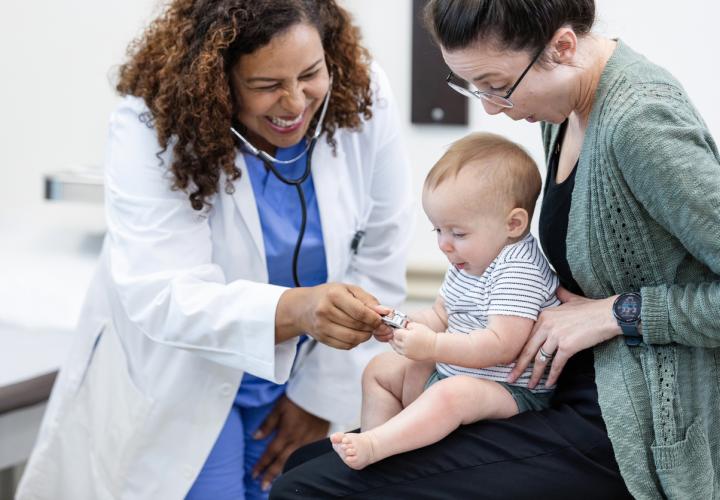
For many families, that care begins in the pediatrician’s office, where providers get to know children and their families and support their health over time.
Connecticut Children’s evidence-based medicine program, CLASP, or Clinical Leaders in Advanced Solutions for Pediatrics, helps strengthen that care by connecting primary care clinicians with pediatric specialty expertise. By bringing these perspectives together, CLASP helps providers make informed decisions, coordinate care and connect children with specialty services when needed.
At Connecticut Children’s, CLASP is part of the Clinical Effectiveness Program. Pediatric specialists and community-based primary care clinicians work together to develop practical, evidence-based resources that support the care children receive in their local pediatric practices.
The goal is simple: help children receive the right care, in the right setting, at the right time, while making it easier for their providers to work together.
Bringing pediatric expertise closer to families
The pediatrician’s office is often a familiar and trusted place for families to receive care. But while a visit with a pediatric specialist can provide valuable expertise, it is not always the most accessible or practical next step for every child or concern.
CLASP is a unique program that helps bring pediatric specialty expertise into the primary care setting. This gives clinicians access to guidance they can use while caring for children in the office families already know.
For example, if a child experiences frequent migraines, their pediatrician may be able to use CLASP guidance to help determine next steps, including treatment options and when a referral to a pediatric neurologist may be needed.
Through an online library of clinical tools, participating primary care clinicians can access diagnosis-specific management recommendations, referral guidance, patient education materials and other resources to use at the point of care.
The tools can help clinicians decide when a condition can be managed in primary care, when additional testing or treatment may be appropriate, and when a child may benefit from seeing a specialist.
This can help families receive best and most up-to-date care closer to home while keeping a clear path to specialty care when it is needed.
Built by pediatric specialists and community providers
CLASP resources are developed through collaboration between pediatric specialists and community-based primary care clinicians, including advanced practice providers. This collaboration helps ensure the tools are practical and relevant to the day-to-day care these teams provide.
Each resource is thoroughly reviewed by a committee of primary care clinicians when it is developed and again every three years to make sure it remains current and aligned with evidence-based practices.
These resources address a wide range of children's health concerns, including migraines, anemia, early puberty, cholesterol concerns and obesity-related health conditions.
For families, much of this work happens behind the scenes. But it can help bring specialized knowledge into the pediatrician’s office and support care that is connected across providers.
Growing access to clinical resources
CLASP resources are used across Connecticut, Western Massachusetts and Westchester County, New York, including in school-based health clinics. Through these connections, Connecticut Children’s pediatric expertise can reach more children and families in the places where they receive care.
CLASP is also exploring new ways to make clinical guidance easier to access. The program is piloting a primary care obesity medication prescribing tool, with broader implementation planned for October 15, 2026.
The team is also participating in Trinity College’s Entevate AI and Quantum Innovation Sandbox Program. Through this project, CLASP is exploring an AI-powered chatbot that could help providers quickly find relevant resources at the point of care.
These efforts support a larger goal: making pediatric expertise easier for providers to find and use so that children and families can access the care they need.
A partnership that benefits children and families
For families, coordinated care means having providers who can work together around their child’s needs.
Sometimes, that means a child can receive care right in the pediatrician’s office with guidance from pediatric specialty experts. Other times, it means connecting with a specialist for additional evaluation or treatment.
CLASP supports both.
CLASP connects primary care with pediatric specialty expertise and practical resources to help children get the care they need.
By bringing people and expertise together, CLASP helps create more connected care experiences for children and families.