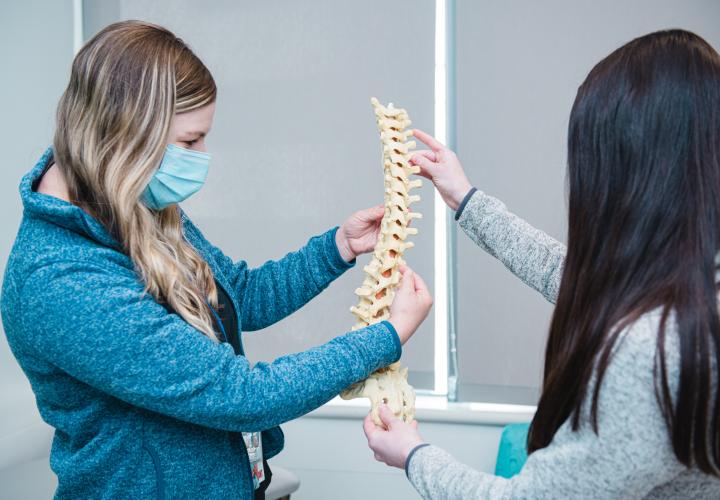
If your child’s school nurse or doctor mentioned scoliosis, it can feel scary. Many parents worry they missed something or did something wrong. The truth is, most worries about scoliosis in kids are based on myths. John Stelzer, MD, pediatric orthopedic & spine surgeon, clears them up.
Concerned your child may have scoliosis?
A quick check with a pediatric spine specialist can provide answers and peace of mind.
Scoliosis in kids is a condition where the spine curves sideways, often developing during growth spurts in childhood or adolescence. The most common type, adolescent idiopathic scoliosis, occurs in otherwise healthy children and has no known cause.
Myth #1: Bad posture or heavy backpacks can cause scoliosis in kids
Fact: Scoliosis is not caused by posture, backpacks, sports, or diet.
The most common type of scoliosis is called adolescent idiopathic scoliosis (AIS). “Idiopathic” means the exact cause of the condition is unknown, and AIS happens for no clear reason in completely healthy kids. We are still researching many potential causes of this scoliosis, but we do know:
Nothing you did caused it.
Nothing your child did caused it.
Myth #2: Scoliosis in kids is rare
Fact: Small curves in the spine are common.
Many people have mild unevenness in their backs and never know it. Scoliosis affects about 3% of the population. With these odds, I like to remind patients that if they have scoliosis, there’s a good chance a few kids in their school may have scoliosis too. Small curves do not cause pain and usually do not need treatment.
Many children only need regular checkups and x-rays to watch the curve. Scoliosis that requires therapy, a brace, or surgery is uncommon.
John Stelzer, MD, Pediatric Orthopedic & Spine Surgeon,
Connecticut Children's
Myth #3: I should have noticed the signs of scoliosis in my child sooner
Fact: Scoliosis often shows up as kids grow.
Many children have no spinal curve until they hit a growth spurt. Small curves can turn into bigger more noticeable curves when a patient grows rapidly. Scoliosis is seen most often in girls from ages 10 to 14, during growth spurts. That is why scoliosis is often found during:
A school nurse screening
A regular doctor visit
Doctors and nurses often use a simple check called the Adams forward bend test, a common scoliosis screening test for children. Your child bends forward and touches their toes which helps to highlight uneven areas in the back.
Myth #4: All types of scoliosis in kids are the same
Caused by bones in the spine that did not form normally
Other Types of Scoliosis in Kids
Some children with medical conditions, like cerebral palsy, can have more serious curves that need special care. There are also other spine conditions, like:
Early-onset scoliosis (before age 10)
Kyphosis, which causes a rounded upper back
Myth #5: A scoliosis diagnosis in kids means they will need surgery
Fact: Most kids with scoliosis do not need surgery.
Treatment depends on:
How big the curve is
How much growing your child still has left
Many children only need regular checkups and x-rays to watch the curve. Scoliosis that requires therapy, a brace, or surgery is uncommon. Growing children with medium sized curves may benefit from a brace to help guide their spine growth to stop curve progression while they are in their growth spurt.
When surgery is needed, doctors use advanced tools to protect the spine and nerves. These tools help them:
See the spine’s detailed anatomy in real time
Place instruments safely and accurately
Monitor nerve signals during surgery
These advances help improve safety and outcomes for children.
If surgery becomes part of your child’s care, advanced technology helps make the procedure safer and more precise.
Intraoperative neuromonitoring tracks nerve and spinal cord signals in real time, helping surgeons detect and prevent potential nerve injury during scoliosis surgery. A dedicated specialist is present and works alongside the surgeon during every procedure at Connecticut Children’s.
Neuronavigation uses real-time 3D imaging and GPS-like guidance to map the spine during surgery. This helps surgeons at Connecticut Children place implants more accurately and safely, while reducing risk to nearby nerves and structures.
Want more articles like this from pediatric experts you trust?
You may want to see a spine specialist at Connecticut Children's if:
A doctor or school nurse notices uneven shoulders, ribs, or hips
Your child’s back looks uneven when bending forward
You want reassurance or a second opinion
Seeing a specialist does not always mean treatment. Often, it just means reassurance or watching carefully if there are signs of scoliosis in children.
Key facts about scoliosis in kids for parents
Scoliosis is not your fault
Children with scoliosis live normal, active lives
Many scoliosis patients never need treatment
Early checks help guide the best care
If your child may have scoliosis, you are not alone — turn to the experts 100% dedicated to kids!