If your care team tells you there is meconium in your amniotic fluid, you may hear a word you’ve never heard before at a moment when you already have a lot going on.

I usually start with the simplest explanation: Meconium is your baby’s first poop. Go ahead and search Google for an image, but you have been warned! 

Babies typically pass meconium after birth. Sometimes, though, a baby passes it into the amniotic fluid before or during delivery which results in meconium-stained amniotic fluid.  When the labor team sees meconium in the fluid, they will often call the pediatric team to be present at the birth to evaluate the baby. 

And it does not automatically mean something is wrong with your baby.

 

Why would my baby poop before birth?

There are several reasons we might see meconium in the amniotic fluid. The longer the pregnancy, the more likely it is. Sometimes, a baby may also pass meconium in response to feeling stress before or during delivery.

If we see meconium, it tells us to pay close attention to how your baby is doing on the monitor during both labor and during the initial transition after birth. But passing meconium and having meconium aspiration syndrome are two different things.

What is meconium aspiration syndrome?

Meconium aspiration syndrome, or MAS, can happen when a baby breathes in the amniotic fluid that contains meconium into their lungs while they are still in utero and then develops breathing problems after birth because of the meconium in their lungs.

Most babies exposed to meconium-stained fluid do not develop MAS.

For some infants the meconium can irritate the lungs and interfere with normal breathing. We may see a baby breathing too fast, working harder to breathe or having difficulty maintaining healthy oxygen levels.


What happens if my newborn baby has trouble breathing?

This is where the care your baby needs can vary quite a bit.

Some babies need relatively little support and do well with just suctioning of the mouth and nose. Others may need help in the NICU with oxygen or continuous positive airway pressure, or CPAP, which helps keep the lungs open and makes breathing easier.

Babies with more significant breathing problems may need breathing support with a ventilator and a medication called surfactant that helps the tiny air sacs in the lungs stay open.  In rare cases, babies can become very critically ill and require a prolonged NICU stay.

Our goal is to give each baby the level of support they need while their lungs recover.
 

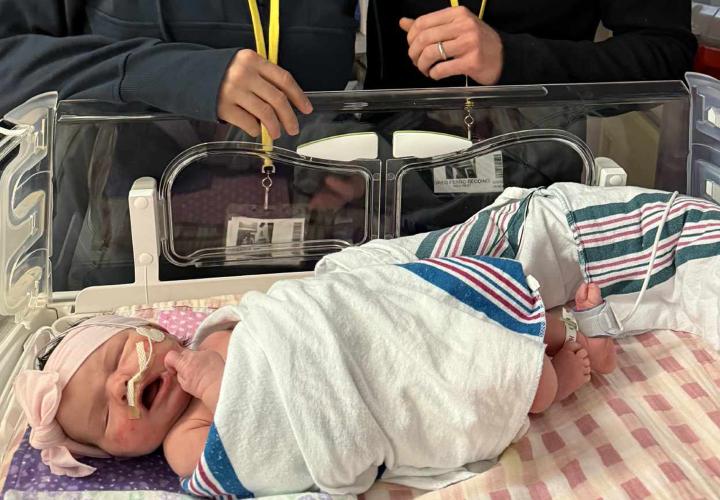
NICU grad, Anna, daughter of a Connecticut Children's nurse.

One Family’s Experience in the NICU With Meconium Aspiration Syndrome

Amanda had what she describes as a “picture-perfect pregnancy” and never expected her daughter, Anna, to need specialized care after birth.

Read Anna's Story

Does my baby need to be suctioned?

Parents sometimes ask me this because they have heard that babies born with meconium need to be suctioned immediately.

That is not routinely done simply because meconium is present. Instead, we assess how the baby is breathing and responding after birth and provide support based on what that individual baby needs.

Will my baby be OK?

This is usually the question parents care about most.

Most babies with meconium aspiration syndrome recover with treatment. How long that takes depends on how much (if any) the lungs have been affected and whether the baby develops any complications.

If your baby needs NICU care, we’ll talk with you about what support your baby needs, what we’re watching for and what needs to happen before your baby is ready to go home.
But I also know that hearing those explanations is different when it’s your baby lying in front of you.
 

Want more articles like this from pediatric experts you trust?

Sign up for our newsletter.