
Service/Program
Glycogen Storage Disease Program & Disorders of Hypoglycemia The Glycogen Storage Disease (GSD) Program & Disorders of Hypoglycemia is a joint program between Connecticut Children’s and the University of Connecticut. Our mission is to pursue research while providing evidence-based care for patients with these diseases. The program is Service/Program
Diabetes Program Diabetes is a medical condition that causes irregular blood sugar levels in the body. When blood sugar levels remain too high for too long, it can cause long-term health problems such as nerve damage, vision impairment, kidney damage, or heart disease. The pediatric Article
Beyond Esophageal Atresia: Marcus’ Story Minutes after Marcus was placed in his mother’s arms for the first time, the nurses gently lifted him away again. They’d heard something alarming in his cry. An X-ray confirmed it: esophageal atresia, a problem with the connection between his esophagus and stomach. He’d just been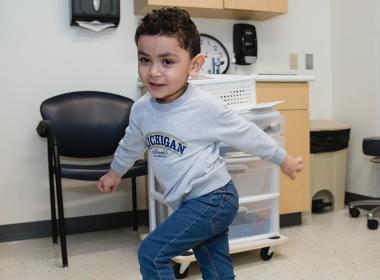
Service/Program
Neurodiagnostic Center Connecticut Children’s Neurodiagnostics Center specializes in providing neurodiagnostic testing for infants, children and adolescents. We offer a variety of neurodiagnostic tests, including electroencephalograms (EEGs), electromyography (EMGs), and long-term EEG monitoring, in Newborn Management of Prenatally Diagnosed Tetralogy of Fallot and Risk of Ductal Dependency Clinical Pathway The diagnosis of Tetralogy of Fallot carries a wide range of treatment possibilities based on the detailed cardiac anatomy. Neonates that are ductal dependent for adequate pulmonary blood flow can be at high risk for severe hypoxemia after delivery if not immediately recognized
Condition
Pulmonary Hypertension Pulmonary hypertension is a type of high blood pressure that affects the lungs and heart. There are a few different kinds of pulmonary hypertension: For example, pulmonary arterial hypertension (PAH) involves problems in the lung’s blood vessels. Pulmonary hypertension caused by Condition
Agenesis of the Corpus Callosum Agenesis of the corpus callosum occurs when the corpus callosum doesn’t develop or only partially develops. The corpus callosum is a central structure within the brain that serves as a bridge of connecting nerves between the two halves of the brain. It facilitates communication Doctor
Michael Isakoff, MD Division Head, Center for Cancer and Blood Disorders | Director, Sarcoma Program | Director, Reid R. Sacco Adolescent and Young Adult Cancer Program | Medical Director, Connecticut Children’s Clinical Trials Unit
- Specialties
- Center for Cancer & Blood Disorders

Doctor
Ilana Waynik, MD Pediatric Hospitalist | Director of Clinical Effectiveness
- Specialties
- Hospital Medicine

Article
Preventing Eye Strain During Your Child’s Screen-Based Learning By Janine Collinge, MD: Whether from homework assignments on a computer or tablet, or remote instruction during COVID-19 quarantines, screens are probably a big part of “back to school” for your child. Connecticut Children’s pediatric ophthalmologist Janine Collinge, MD, shares tips.
Article
GROW Thoughtful: Danny’s Story One day, when Danny Sullivan was 8 years old, he began to feel very tired. Everyone thought it was allergies, maybe, or a growth spurt. He’d always been a healthy kid, with nothing more than the occasional cold. But this time, it got worse. Suddenly, he could barely stand up. His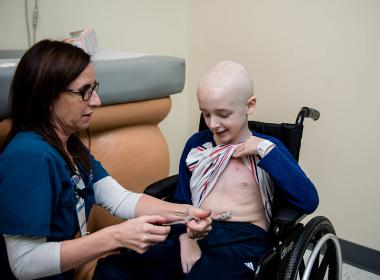
Article
Going Beyond Clinical Care: Improving Housing Conditions and Health Outcomes Fredrik was two months old when he started struggling to keep down food. No matter what parents Marie and Josh Pinheiro tried, “he was spitting up and vomiting at all hours of the day,” says Marie. “Nothing helped.” Two months later, the wheezing and coughing started. At an age
Service/Program
Hearing Loss Disorders Childhood hearing loss, whether congenital or acquired, can be worrisome for parents. Connecticut Children’s otolaryngologists have the expertise to diagnose and manage childhood hearing disorders, and work closely with our pediatric audiologists to help educate parents and
Service/Program
Pediatric Psychogastroenterology Program Connecticut Children’s Pediatric Psychogastroenterology Program focuses on the “brain-gut” connection in children and adolescents with gastrointestinal disorders such as inflammatory bowel disease (IBD). These conditions can be difficult to manage or cause feelings of