
How many of us have participated in a training only to forget what we learned shortly thereafter? It’s not just you—we all have a mountain of knowledge collecting dust somewhere in our brains. Childhood Prosperity Lab (the Lab) leverages the science of adult learning theory to actualize the power of practice change through their signature Community of Practice (CoP) on the Strengthening Families Protective Factors Framework (SFPFF). The Lab defines practice change as the intentional shift of attitudes, behaviors, and skills in one’s role as a result of knowledge acquisition and active training methods that are supported over time.
The Lab’s Community of Practice on Strengthening Families
The SFPFF is a research-informed, strengths-based framework that helps professionals and families identify and build protective factors in their everyday lives. In contrast to risk factors, protective factors are environmental conditions or personal attributes that promote positive health outcomes. The Center for the Study of Social Policy created the SFPFF, which is comprised of five protective factors that promote child development and reduce the likelihood of child abuse and neglect: parental resilience, social connections, concrete support in times of need, knowledge of parenting and child development, and children’s social and emotional competence.
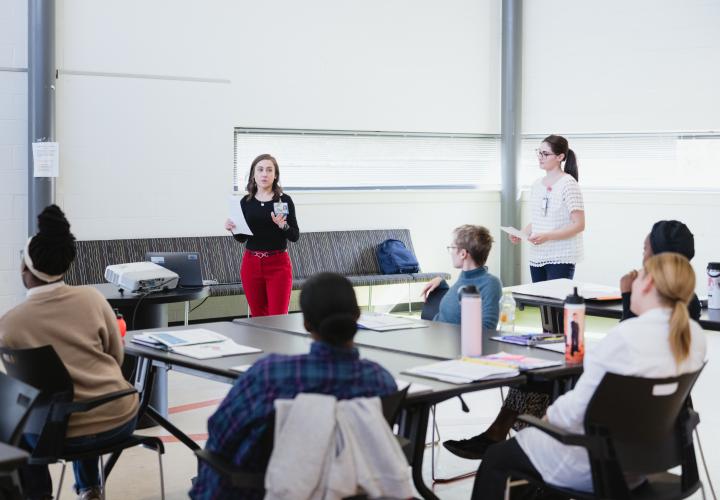
As of December 2025, the Lab has facilitated three CoP’s on the SFPFF with service providers and system leaders affiliated with North Hartford Ascend. Each CoP is structured as a series of five learning sessions and three collaboration sessions. Learning sessions are curriculum-based workshops that provide a foundational understanding of the protective factors while offering participants opportunities to practice emerging skills, such as active listening. Collaboration sessions are semi-structured discussions focused on skill and practice change across the cohort.
Between collaboration sessions, participants complete a Plan, Do, Study, Act (PDSA) cycle to monitor practice change related to a previously identified strategy for strengthening families. These sessions are intentionally spaced one month apart, as repetition of key information and ongoing support catalyze long-term learning and sustained practice change.
Both Childhood Prosperity Lab and North Hartford Ascend are part of Connecticut Children’s Office for Community Child Health (OCCH). These efforts reflect OCCH’s focus on population health, cross-sector coordination, and strengthening alignment across services so families experience care and support as connected. Through their work, participants are able to apply what they learn in the CoP to everyday practice, helping families build protective factors and resilience in their communities.
In addition to collecting quality and satisfaction data throughout the CoP to make real-time adjustments to materials and facilitation for continuous quality improvement, the Lab follows up with participants six months after the final activity to assess the extent to which information, concepts, and skills have informed everyday practice. Notably, 93% of respondents across two of the three CoPs reported applying the framework’s concepts very often or always when surveyed six months after completion.
When asked which tools and concepts they were applying, participants shared several meaningful examples. One participant shared that they “were able to support families throughout the November SNAP crisis. Through collaboration with partner organizations, we ensured that over 100 families had food for the holiday and throughout the month. We have also built more capacity for December,” demonstrating a tangible application of concrete support—one of the five protective factors.
The Art and Science of Adult Learning
The Lab integrates core tenets of the Universal Design for Learning Guidelines (UDLG), developed by CAST, into its SFPFF CoP to optimally support participant learning. The UDLG includes:
- Engagement (the "why" of learning): recruiting interest, sustaining effort and persistence, and self-regulation.
- Representation (the "what" of learning): perception, language and symbols, and comprehension.
- Action & Expression (the "how" of learning): physical action, expression and communication, and executive function.
In the SFPFF CoP, learners engage with a curriculum that includes videos, discussions, readings, games, and other interactive activities—diversifying the “how” of learning. Multiple learning modalities support participants with varied abilities and serve as reinforcers of key content. To strengthen the “why” of learning, the curriculum draws on participants' lived experience by encouraging reflection on existing strengths and identification of real-world examples from their professional roles.
“When a flower doesn’t bloom, you fix the environment in which it grows, not the flower.”
— Alexander den Heijer
Interested in learning more about the Lab’s SFPFF CoP? We are launching a CoP in 2026! Email Childhoodprosperitylab [at] connecticutchildrens.org (Childhoodprosperitylab[at]connecticutchildrens[dot]org) to receive registration information.