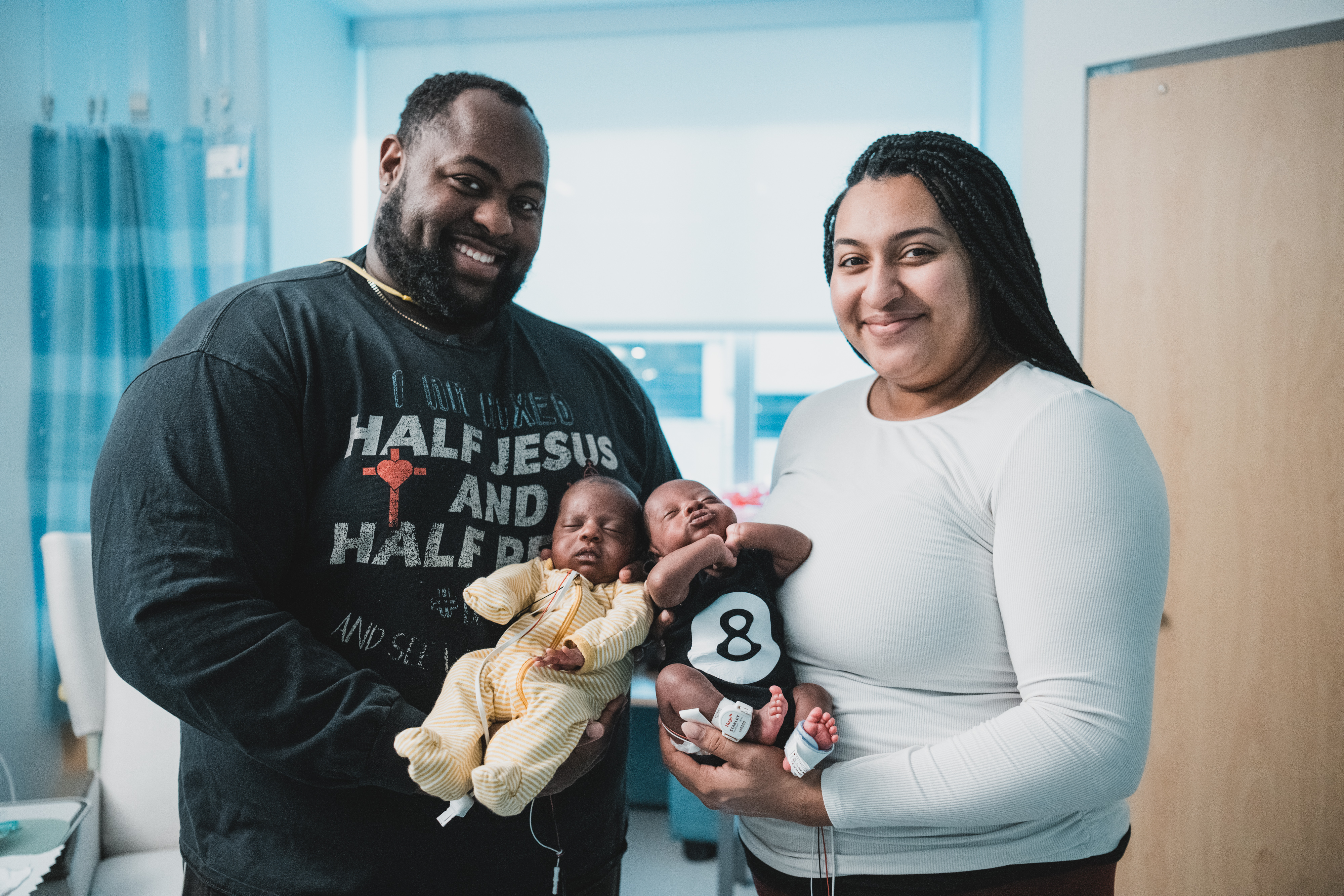
A rare TTTS diagnosis led Essence and Eric to Connecticut Children’s, where a specialized procedure—and weeks of NICU care—changed everything.
When Essence and Eric found out they were expecting identical twin boys, they knew the pregnancy would be unique. The twins were monochorionic-diamniotic or “mono-di”—meaning they shared a placenta but had separate amniotic sacs.
But early in the pregnancy, they received an unexpected diagnosis: twin-twin transfusion syndrome (TTTS)—a rare and potentially life-threatening condition that affects identical twins sharing a placenta, where blood does not flow evenly between them.
“We were told that without intervention, they likely wouldn’t survive,” Essence said.
TTTS happens in pregnancies with identical twins who share a placenta. Abnormal blood vessel connections can cause one baby to get too much volume while the other gets too little—putting both at serious risk.
For families facing a TTTS diagnosis during pregnancy, early intervention at a fully comprehensive fetal care center is critical.
At just 18 weeks, Essence was referred to the Fetal Care Center at Connecticut Children’s, a leading center for TTTS treatment and fetal surgery in Connecticut and the Northeast.
Fetal Surgery at 18 Weeks: A Life-Saving Intervention at Connecticut Children's
During a delicate laser surgery for TTTS, Dr. Crombleholme used a fetoscope to identify and seal abnormal blood vessel connections in the placenta. This procedure—known as selective fetoscopic laser photocoagulation—helps restore balanced blood flow between twins.
Dr. Crombleholme has spent more than 30 years leading the way in treating TTTS with selective fetoscopic laser photocoagulation. With over 1,400 fetal surgeries performed, he’s widely recognized as one of the most experienced fetal surgeons in the world.
“It was scary going into it, but I trusted him completely,” Essence said.
Eric added, “I trust that man with my life. He is the GOAT.” (Greatest Of All Time)
The procedure was successful, and the twins responded well. “My husband always says, ‘that’s fire, that’s fire,’” Essence said. “And after the surgery, Dr. Crombleholme caught onto the joke, too, and said it was, ‘fire.’ That moment stuck with us.”
In the weeks that followed, Essence was closely monitored with frequent ultrasounds—often spending hours at a time with the care team.
“You build real relationships when you’re there that often,” she said. “They weren’t just caring for the babies—they were caring for us.”
Would you like to schedule an appointment with our Fetal Care Center?
At 28 weeks, Essence’s water broke unexpectedly. She was admitted to Hartford Hospital, where she remained for about a week and a half before delivering her sons, Xavier and Bryson, prematurely.
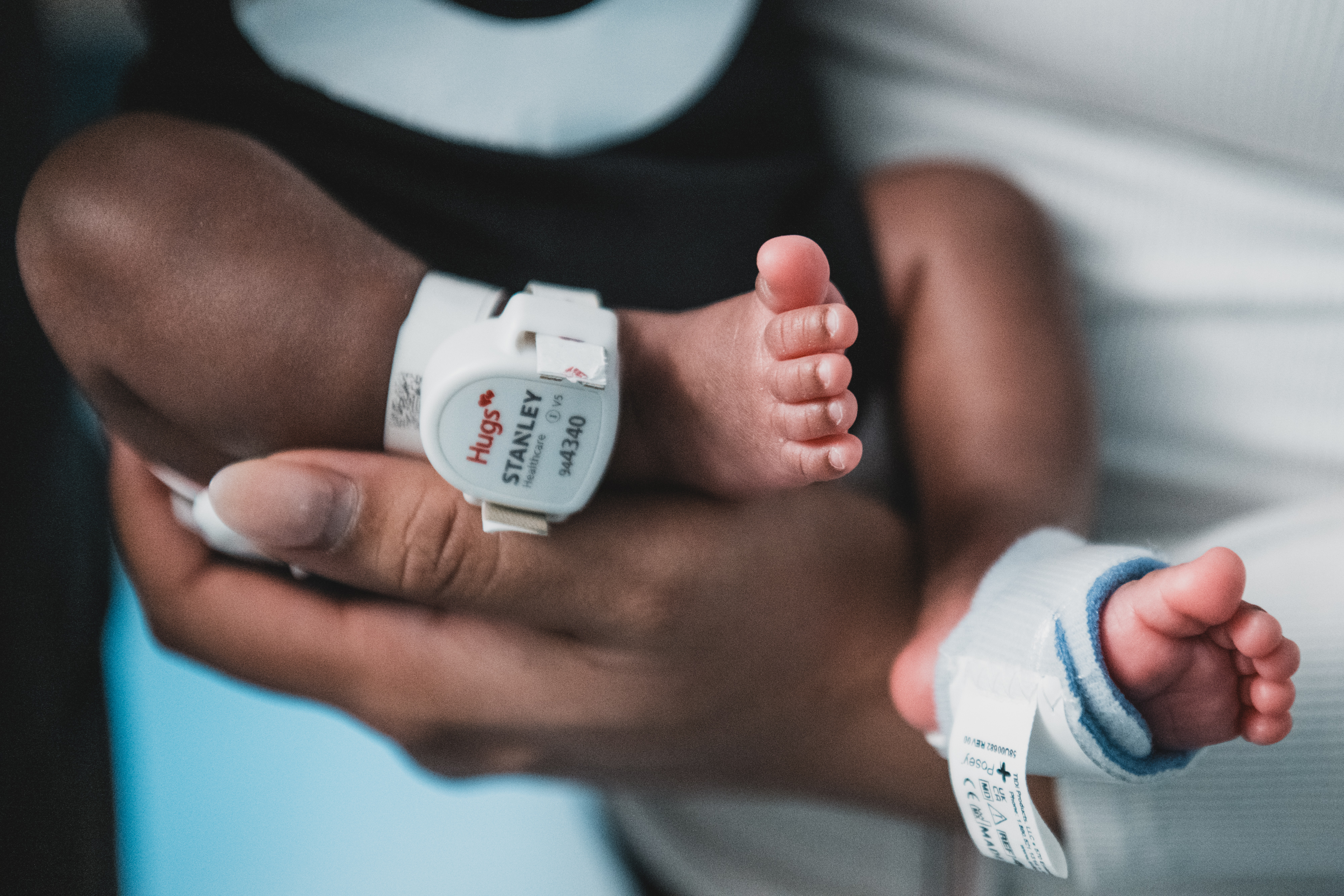
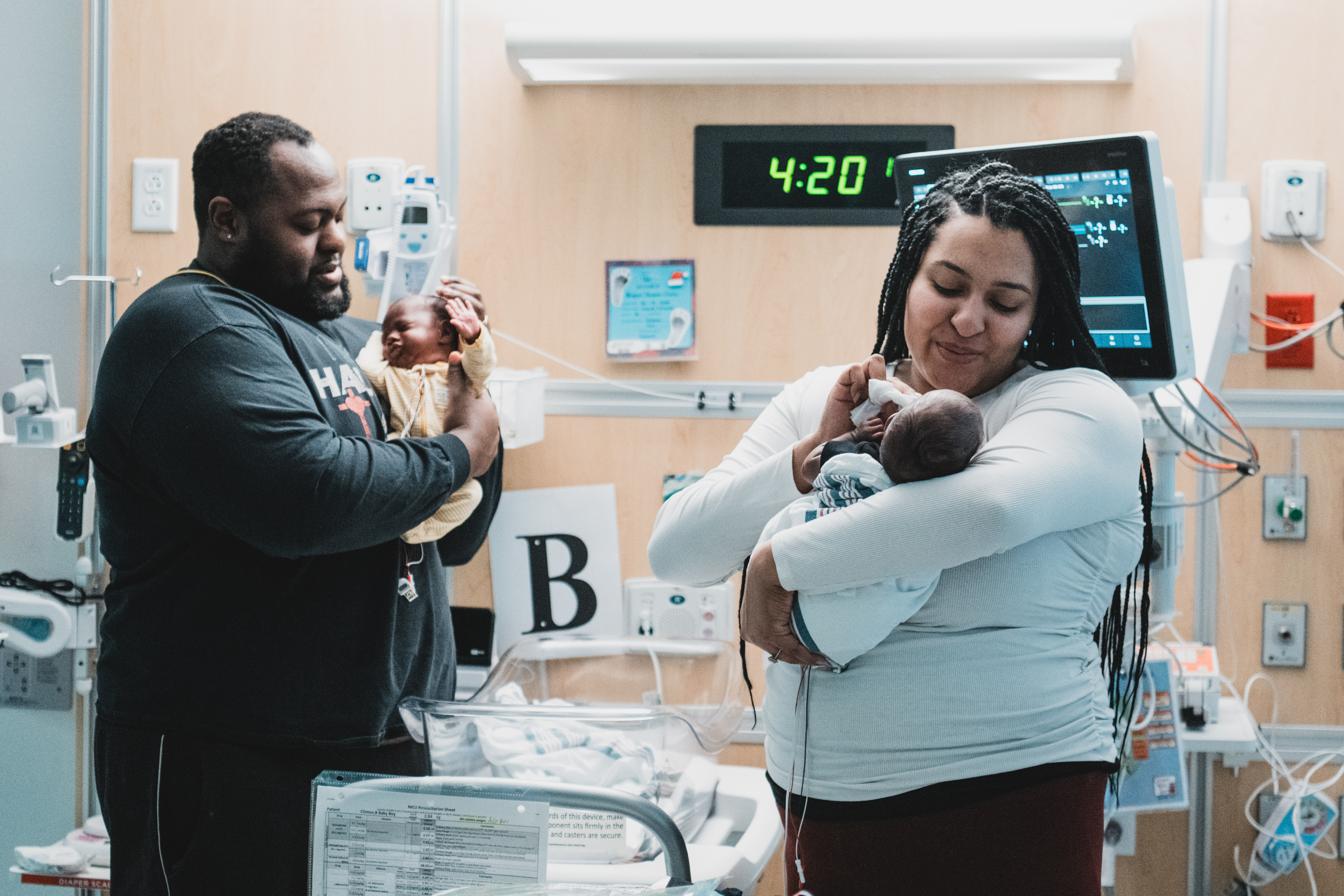
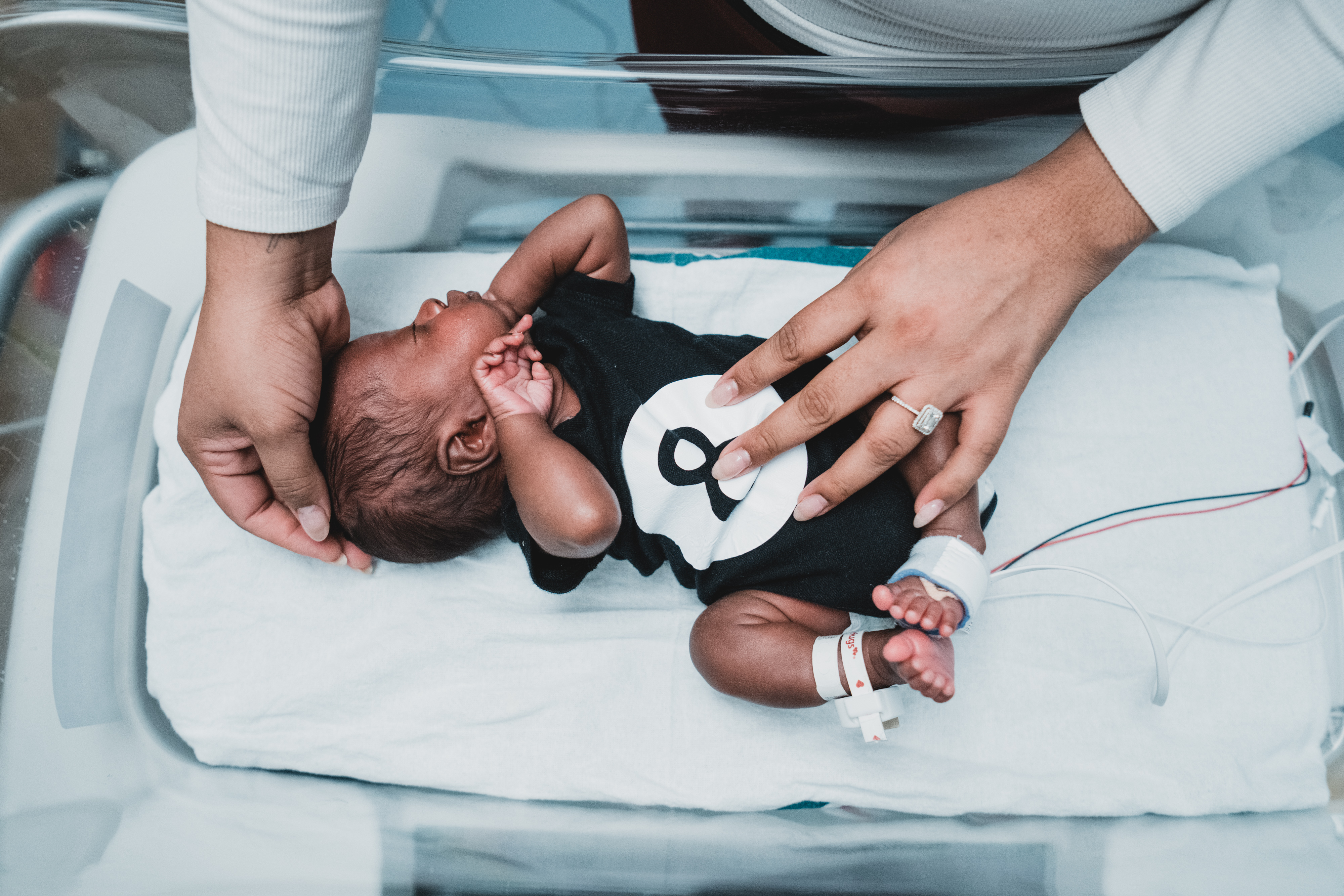
Like many premature twins born at 30 weeks, both babies required specialized care in the Neonatal Intensive Care Unit (NICU). They initially stayed at Connecticut Children’s NICU at Hartford Hospital before being transferred to Connecticut Children’s NICU 6 in the new Tower.
“We called the new Tower the penthouse suite,” she said with a laugh. “The rooms were connected, there was space for both of them, and for us. It really felt like they had thought of everything.”
From dim lighting and in-room bathing areas to comfortable sleeping spaces for parents, the environment helped ease an incredibly stressful time.
Clinically, both babies needed support common in the NICU for preemies, including:
CPAP for breathing support
Incubators to maintain body temperature
Phototherapy for jaundice (bilirubin management)
Feeding support through nasogastric (NG) tubes
“They were on CPAP at first, then feeding tubes,” Essence said. “It was a lot—but the nurses guided us through everything.”
We called the [NICU in the] new Tower the penthouse suite... The rooms were connected, there was space for both of them, and for us. It really felt like they had thought of everything.
Essence,
Xavier and Bryson's Mom
How Connecticut Children's Supports the Whole Family
As a former pediatric nurse, Essence had some familiarity with medical equipment and monitoring—but the experience still felt entirely different as a parent.
“I understood what was happening clinically,” she said. “But at the end of the day, these were my babies.”
She credits the care team with not only treating her sons, but supporting her and Eric throughout their NICU journey.
“The nurses were amazing,” she said. “They taught us so much and truly cared.”
Support extended beyond bedside care:
• Lactation consultants helped with pumping, milk supply, and early breastfeeding challenges • Occupational therapists supported feeding development • A NICU psychologist provided emotional support for parents navigating stress and uncertainty
“At first I thought, ‘What does a psychologist do in the NICU?’” Essence said. “But they were there for us—for whatever we needed. And sometimes, just to make us laugh.”
Eric, an actor who has appeared in television roles and national commercials, leaned on perspective and support systems throughout the experience.
“Lean on whatever gives you strength—your faith, your family, your support system,” he said. “And accept help.”
Life After the NICU: Thriving at Home
After several weeks in the NICU, the day finally came to bring Xavier and Bryson home.
“It felt surreal,” Essence said. “Taking them outside for the first time—it was scary. But after that first pediatrician visit, it started to feel real.”
Today, both boys are thriving.
“You’d never know they were preemies,” she said. “They smile when we walk into the room. Bryson is more playful, and Xavier gives you this little side-eye. They already have their personalities.”
Now enrolled in Birth to Three services available to premature infants, they are continuing to grow and develop without the need for additional specialists.
Advice for Parents Facing a Twin-Twin Transfusion Syndrome Diagnosis
Looking back, Essence and Eric share advice for other families navigating a high-risk pregnancy or TTTS diagnosis:
“Take it one day at a time,” Essence said. “Don’t get too far ahead in the ‘what ifs.’ That will overwhelm you.”
She also encourages parents to advocate for their children:
“Never feel intimidated. Ask questions. Speak up—these are your babies.”
Eric adds:
“Trust whatever grounds you—your faith, your family—and don’t be afraid to accept help.”
For this family, what began as an unsettling diagnosis of twin- twin transfusion syndrome became a story of expert care, resilience, and two thriving little boys—thanks to timely fetal surgery, coordinated NICU care, and a team that was always in their corner.
⭐We Want To Hear From You⭐
Did you have a great experience at Connecticut Children's? Tell us about it. By leaving a review, you are helping many families who are in need of care.